Your Liver and Your Hormones: How Phase 1 and Phase 2 Detox Clear Estrogen
So far in this series we’ve covered the weird little signs that you might be low on something, and how those same nutrients become your hormones and brain chemicals. If you missed these two articles, go back to my page and give them a read, each one builds on the next. This last piece is about the exit route, dear reader, because a hormone that has done its job still has to leave.
How the Liver Clears Hormones
Making hormones is only half the job. Your body also has to break them down and clear them out, and most of that work happens in the liver, in two phases. Both phases require nutrients to complete the job, so you can guess that if you’re low on these nutrients, your body will start to get sluggish in clearing hormone metabolites. When estrogen metabolites in particular aren’t efficiently detoxified, signs and symptoms of “estrogen dominance” can manifest. Now - this isn’t a diagnosis, think of it more as a descriptive term of what happens in the body when estrogen isn’t efficiently detoxified. It manifests as heavy periods, breast tenderness, and mood shifts. Completely different mechanism than what occurs during perimenopause when estrogen becomes erratic.
What Liver Detox Really Means
The word has been dragged through a lot of juice cleanses, so let me reclaim it. Your liver isn’t a filter that clogs up with toxins and needs to be flushed. It’s a chemical processing plant.
Hormones, medications, alcohol, and caffeine are mostly fat-soluble, which means your body can’t simply rinse them out in urine. The liver’s job is to convert them into water-soluble forms that can leave. It does this around the clock, with no special tea required. What it does need is a steady supply of nutrients.
Phase 1 Liver Detoxification and the Nutrients It Needs
In phase 1, a family of iron-containing enzymes (cytochrome P450 enzymes if you like the scientific jargon) changes the structure of a hormone like estrogen, producing several different intermediate forms called metabolites. Some of these are fairly benign. Others are more reactive and need to be dealt with quickly.
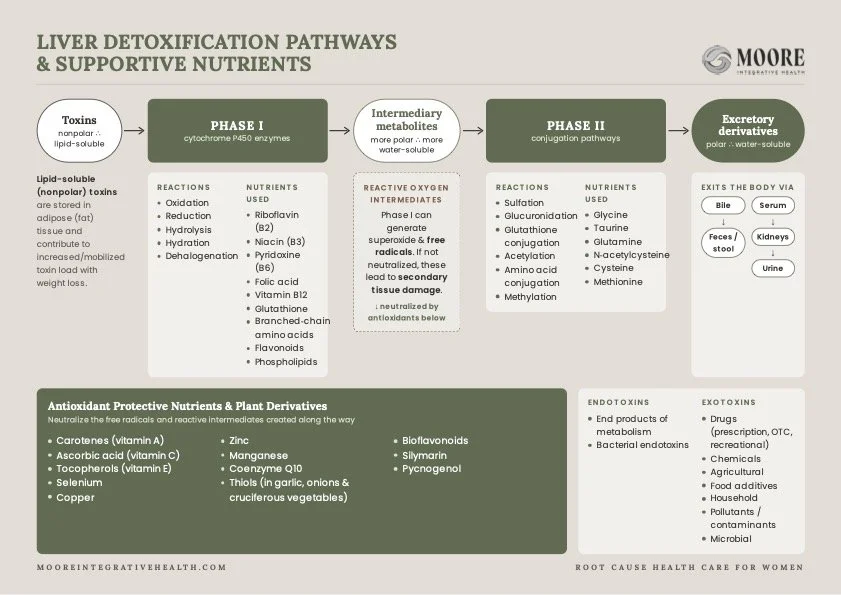
This step leans on all B vitamins (especially B2, B3, B6, folic acid, B12), iron, and magnesium. It also throws off reactive byproducts, so it needs antioxidants like vitamins A, C, and E, manganese, plus selenium and zinc, to keep things tidy. Glutathione (your body’s major antioxidant) becomes important and is built from Cysteine (often the rate-limiting or controlling factor in how much gets made), Glutamate (glutamic acid), and Glycine. All of these are amino acids and come from PROTEIN in the diet. Flavonoids from colorful fruits and vegetables are important, as are phospholipids from healthy fats in the diet like wild caught salmon, sardines, nuts and seeds, coconut, etc.
A few everyday things pull on the same enzymes. Alcohol, smoking, and a number of medications all go through phase 1, so they compete for its attention. On the helpful side, cruciferous vegetables (broccoli, cabbage, kale, and Brussels sprouts) contain compounds that appear to nudge estrogen toward its gentler metabolites.
Below is a quick guide that I use in my practice to help educate my clients on proper liver detoxification support.
Phase 2 Liver Detoxification: Methylation, Sulfation, and Glutathione
In phase 2, your liver attaches a molecule to each intermediate. That neutralizes it and makes it water-soluble, so it can leave the body. There are several routes, and each has its own shopping list:
Methylation runs on folate, B12, B6, and magnesium. It’s a main route for neutralizing the more reactive estrogen metabolites.
Glucuronidation handles a large share of estrogen, and it depends on a steady energy supply.
Sulfation depends on sulfur-rich amino acids, which come from eggs, fish, meat, and legumes, with extra help from onions, garlic, and cruciferous vegetables.
Glutathione (conjugation), your body’s main antioxidant, is built from three amino acids, with selenium as a helper.
Notice that protein shows up again and again. A low-protein diet shortchanges phase 2 directly. It’s also why crash diets and juice cleanses work against the very process they claim to support: they supply almost no protein at all.
If phase 1 is humming along but phase 2 is short on supplies, those intermediates can linger. In practice, I think of low protein, low B vitamins, and low magnesium as the most common ways this system gets under-resourced.
Phase 3: Gut Health, Fiber, and the Estrobolome
Once a hormone is packaged, it travels in bile to your gut and leaves in your stool, with a smaller share going out through the kidneys. Two things can go wrong at this stage.
The first is constipation. When things move slowly, those packaged hormones sit in the gut longer than they should. The second is that certain gut bacteria make an enzyme that snips the package back off, freeing estrogen to be reabsorbed into your bloodstream. Researchers have a name for the community of gut bacteria that handle estrogen: the estrobolome.
Fiber helps on both counts. It keeps things moving, and it feeds the bacteria you want more of. This is why fiber and regular bowel movements matter more for hormones than anyone wants to discuss at dinner.
What Slows Estrogen Detoxification?
When I’m looking for why a woman’s clearance might be sluggish, these are the usual suspects:
Not enough protein, which shortchanges phase 2.
Low B vitamins and magnesium, which slow both phases.
Alcohol. Your liver treats it as the priority, and processing it uses up B vitamins and glutathione.
Constipation and low fiber, which back up the exit.
Chronic under-eating, which leaves the whole system short on energy and raw materials.
One honest note: the biochemistry here is well mapped, but research on how much a mild shortfall changes your day-to-day hormone symptoms is still limited. I treat this as a reason to cover the basics, not a reason to buy a “liver detox” kit.
Nutrient Deficiencies and Hormone Imbalance Before Perimenopause
None of this waits until your forties. I see the same pattern in women in their twenties and thirties, where it shows up as the hormone complaints we’re told are just part of being a woman.
PMS and PMDD. Calcium and vitamin B6 have the best research behind them for easing premenstrual symptoms, and magnesium is often low in women who struggle most.
Heavy periods. Heavy bleeding drains iron, and low iron leaves you exhausted, anxious, and shedding hair. It’s a loop that’s hard to get out of without addressing both sides.
Irregular or missing cycles. Under-eating, especially alongside hard training, is one of the most common reasons a cycle goes quiet.
PMOS and blood sugar swings. Insulin resistance sits at the center, and magnesium, zinc, and vitamin D are frequently low alongside it.
Thyroid trouble. A thyroid short on iron, selenium, iodine, or zinc has a hard time keeping up.
The postpartum years. Pregnancy and breastfeeding draw heavily on iron, B12, and omega-3 fats, and many women never get the chance to refill before the next demand arrives.
I think of it as a bank account. A woman who has been running a quiet deficit through her twenties and thirties tends to arrive at perimenopause already overdrawn.
Nutrient Deficiencies and Hormone Imbalance Before Perimenopause
Perimenopause and nutrient deficiencies share a symptom list. Fatigue, poor sleep, anxiety, thinning hair, dry skin, and brain fog show up on both, which makes it very easy to blame hormones for all of it.
So when a woman asks me, “Is it perimenopause, or is it low iron?” my honest answer is often: both. One doesn’t cancel out the other. They stack.
Perimenopause can also drain your reserves faster. Periods often get heavier and closer together in these years, and every heavy period is iron walking out the door. Sleep gets choppier, stress runs higher, and plenty of us are eating less (and less protein) than we think.
And remember the two mechanisms from the top of this piece. In perimenopause, estrogen surges and drops erratically because of what the ovaries are doing, which has nothing to do with clearance. But a woman whose clearance was already under-resourced may have less capacity to handle those surges when they come. Both things can be true in the same body.
Meanwhile, falling and fluctuating estrogen is already changing your skin, your hair, and your sleep on its own. A body that’s low on raw materials has less to work with when those shifts arrive.
If you’re in the thick of perimenopause and want structured support, that’s what my virtual programs are for.
How to Support Liver Detox and Hormone Balance
The same things I’d tell you whether you’re 28 or 48.
Eat enough protein, spread across the day and starting at breakfast.
Eat cruciferous vegetables most days. Broccoli, cabbage, kale, and Brussels sprouts all count.
Get your B vitamins and magnesium from food first: leafy greens, beans, eggs, nuts, seeds, and whole grains.
Feed the exit route. Fiber and water keep things moving.
Be honest about alcohol. Even moderate drinking competes for the same pathways.
Test before you supplement. Ferritin with a full iron panel, vitamin D, B12, and a thyroid panel are a reasonable start.
Ask why. If you’re low, find out whether it’s intake, absorption, or loss.
Correcting a deficiency won’t “fix” perimenopause, and it won’t erase a rough cycle overnight. But it takes one stressor off a system that’s already working hard, and in my experience that can change how the whole thing feels.
Thank you for reading all three parts. If this series sounded like your story, hit reply or leave a comment. I read every one. And if you’d like one-on-one support with hormone balance, you can work with me here.
Chelsie Moore, MS, CNS, LDN, is a functional medicine clinician and integrative nutritionist at Moore Integrative Health in Portland, Oregon.
This post is for educational purposes only and isn’t a substitute for individualized medical advice. Please talk with your provider before starting any supplement.